Summary of climate disasters on the planet, November 19–25, 2025
In Indonesia, volcanic ash reached the stratosphere; in Thailand, a “rain bomb” trapped tourists; in Ethiopia, a volcano awakened for the first time in 12,000 years; in Australia, giant orange-sized hail fell; and in Russia, anomalous atmospheric phenomena were recorded. Learn about these and other climate events of the past week, from November 19 to 25, 2025, right now.
Indonesia
East Java Province in Indonesia was affected by a powerful eruption of Mount Semeru. Since mid-November, the volcano had been showing increasing activity. For several days, ash clouds rose above the summit, and on November 19, pyroclastic flows burst from the crater and rushed down the Besuk Kobokan riverbed. They descended one after another, traveling up to 14 km (8.7 mi) down the southern and southeastern slopes. The ash column rose to a height of up to 18 km (11.2 mi), reaching the stratosphere, which in tropical latitudes begins at about 15–17 km (9.3–10.6 mi) above sea level.
The escalation of volcanic activity was so rapid that the alert level was raised to the maximum in just one hour, and the exclusion zone radius was expanded to 8 km (5 mi), and up to 20 km (12.4 mi) in the southeastern sector.
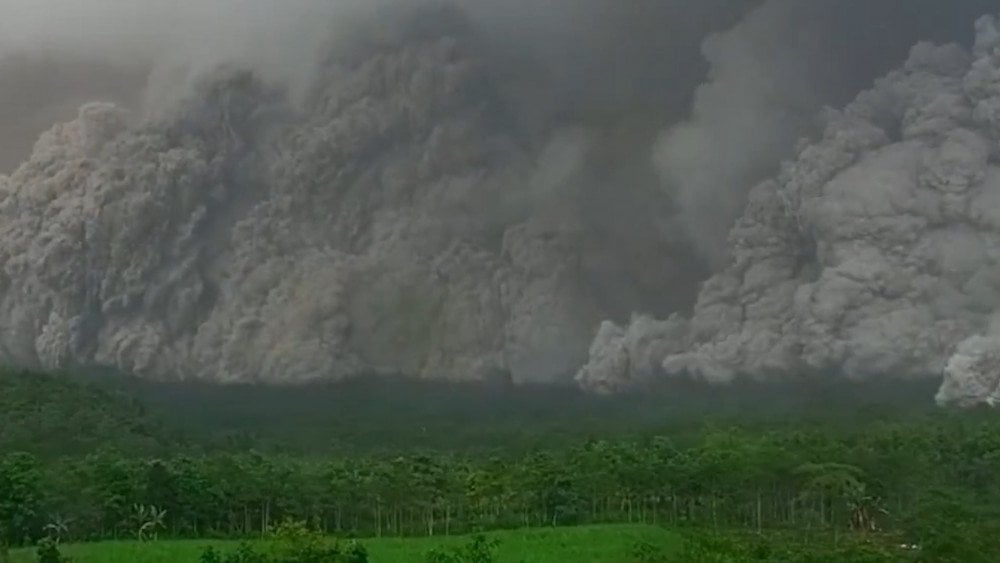
Eruption of Mount Semeru: the ash column rose to a height of up to 18 km (11.2 mi), Indonesia
In several communities, red-hot ash and rock debris destroyed homes and damaged a school, a medical facility, and an electrical substation. According to the National Disaster Management Agency (BNPB), the communities of Supit Urang and Oro-Oro Ombo in the Pronojiwo district and the Penanggal community in the Candipuro district were affected. More than 200 hectares (about 495 acres) of farmland were destroyed, and over 140 heads of livestock died.
At least three people sustained serious injuries. Among the injured was a married couple traveling across the Gladak Perak bridge: their motorcycle skidded on a layer of hot ash, and they suffered burns on about 20% of their bodies.
In several settlements, residents reported a strong sulfur smell that caused coughing and breathing difficulties.
More than 1,100 people were forced to leave their homes; they were accommodated in schools, mosques, and administrative buildings.
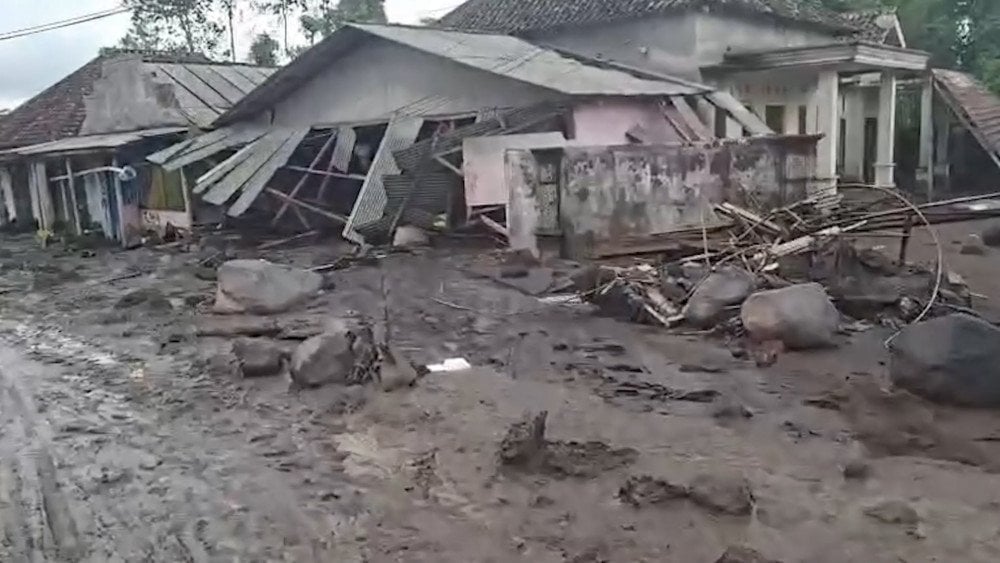
Damaged buildings after the eruption of Mount Semeru, East Java Province, Indonesia
An evacuation was also organized for 187 climbers, porters, and guides who were at Lake Ranu Kumbolo on the northern slope of Semeru at the time. Due to darkness and bad weather, they were forced to spend the night on the mountain and were only able to leave the potential danger zone the following day.
By November 23, the situation began to stabilize, and some residents returned home. However, Mount Semeru remained at the maximum danger level, and by the next morning, it emitted white smoke rising up to 1 km (0.6 mi) above the summit, while 44 earthquakes were recorded within six hours.
Vietnam
Torrential rains that did not stop for many days caused unprecedented flooding in South Central Vietnam.

Unprecedented flooding in Vietnam: streets turned into raging rivers
Rainfall exceeded all historical norms. In less than 24 hours, major rivers broke records set decades ago: the Dinh River surpassed the 1986 level, the Ky Lo topped the 2009 flood peak, and the Ba River broke its 1993 record. Local hydropower plants were forced to release water, further exacerbating the destructive impact of the floods.
In Son Hinh District of Dak Lak Province — one of the hardest-hit areas — as much as 1,861 mm (about 73.3 in) of rain fell in just one week, from November 15 to 21.
Water flooded homes so rapidly that people had to break through roofs to escape the powerful currents. Many families were forced to remain there for about 30 hours. Social media was flooded with calls for help.
In Khanh Hoa Province, the water depths in some areas reached 4–5 m (13–16 ft).
Residents of Cat Tien District in Lam Dong Province were cut off from the outside world by flooding. Authorities used boats and other equipment to deliver food and essentials.
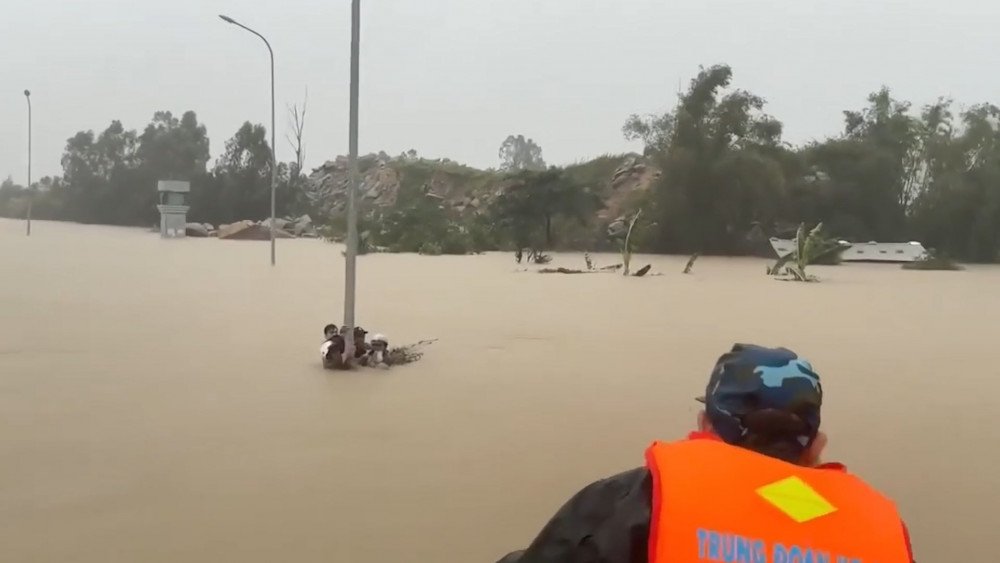
People hold onto a pole while waiting for help amid raging floodwaters, Vietnam
According to the Department of Dike Management and Disaster Prevention, as of November 26, a total of 98 people died nationwide from the massive flooding, with another 10 still missing.
Nearly 1.2 million consumers were left without electricity. Sections of two national highways were damaged by landslides.
More than 200,000 homes were flooded, some of them completely destroyed. The disaster destroyed over 90,000 hectares (about 222,400 acres) of rice and other crops, devastated fish farms, and killed nearly 1 million livestock and poultry.
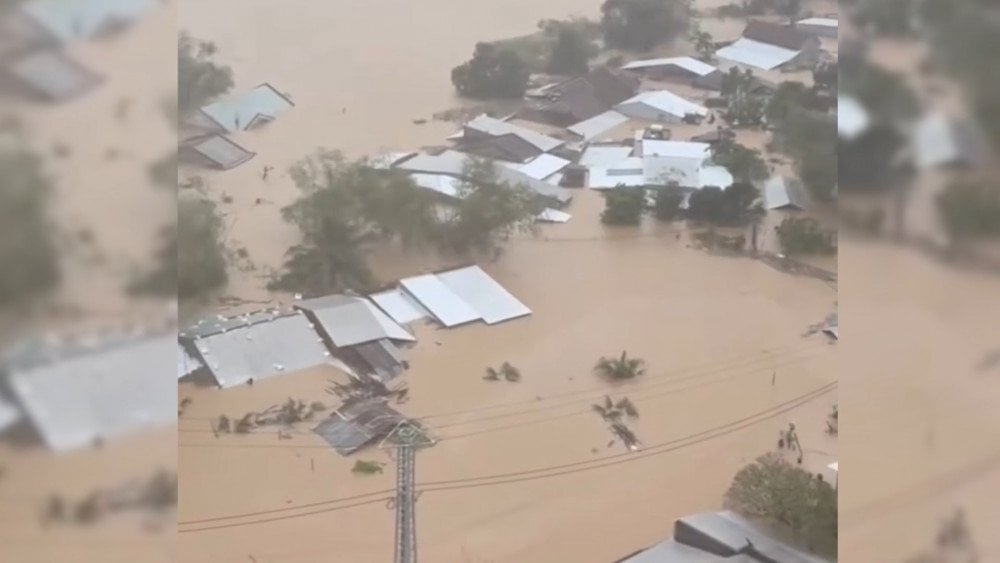
Flooding in Vietnam: residential areas submerged, thousands of people left without homes and property
To deal with the aftermath, provincial police forces have deployed nearly 42,000 officers with more than 3,200 vehicles for rescue operations.
Russia
On November 22, the Chelyabinsk Region was hit by freezing rain. The federal M-5 “Ural” highway was covered with ice. Due to numerous traffic accidents, multi-kilometer traffic jams formed, and on some sections, traffic was completely blocked.
In the Satka District, at a temperature of −5 °C (23 °F), rain began to fall instead of the expected snow, instantly freezing on supercooled surfaces.

Freezing rain led to accidents: a truck skidded off the icy highway, Chelyabinsk Region, Russia
Because of the black ice, dozens of people were injured and sought medical assistance.
A similar situation developed in Tyumen, where a thick layer of ice covered trees, cars, railings, roads, and sidewalks, turning the city into a dangerous skating rink.
From November 21 to 24, anomalous thunderstorm activity was recorded in the Central Federal District of the country. On November 22, in the village of Yakovlevo, Terbunsky District of the Lipetsk Region, a thunderstorm was accompanied by hail up to 2 cm (0.8 in) in diameter.
Over the Bryansk, Kaluga, Oryol, Tula, and Smolensk Regions, lightning discharges were unusually powerful and frequent for late November. On November 24, in the Oryol Region, a lightning strike with a current of 486 kA was recorded.
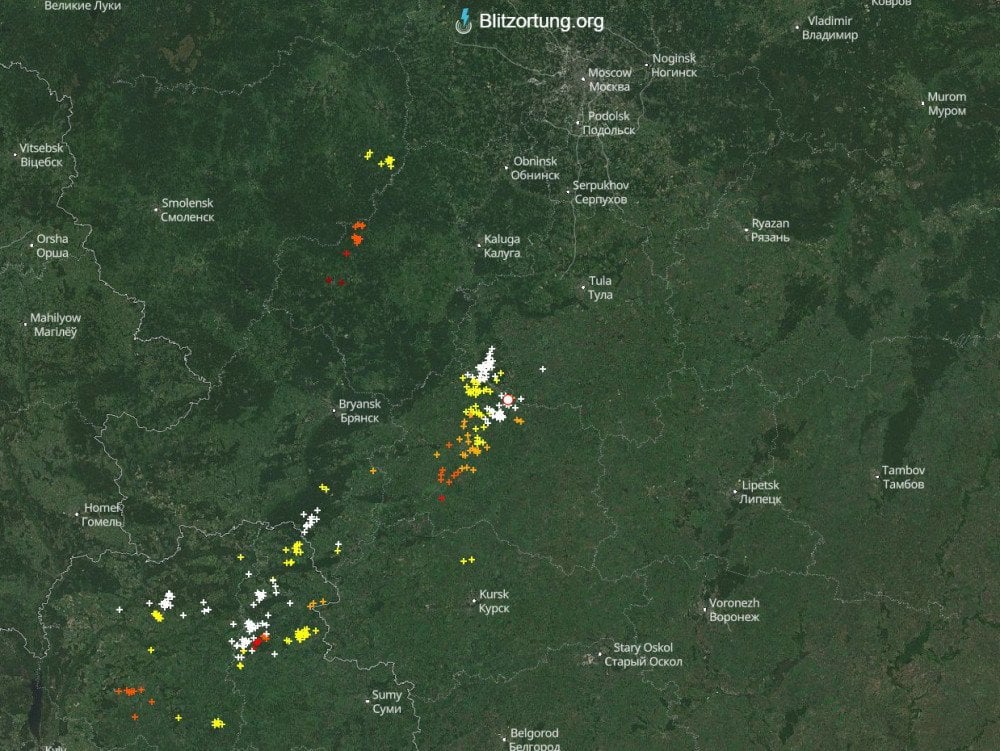
Anomalous lightning activity in the Central Federal District of Russia
For comparison, the amplitude of an average lightning strike is about 30 kA, which is 16 times less.
The intensity of the electromagnetic pulse was so high that its signal was detected by instruments at a distance of 700 km (about 435 mi) from the source, although usually at such distances it is already weak or not detected at all.
Such lightning activity levels in temperate latitudes would be anomalously high even for summer, and for late November — this is a truly unprecedented event.
Ethiopia
On November 23, a sudden powerful eruption of the Hayli Gubbi volcano occurred in Ethiopia.
The ash plume reached 15 km (about 9.3 mi) in height, disrupting air corridors connecting Africa, the Middle East, and South Asia. Based on a warning from the Toulouse Volcanic Ash Advisory Centre (VAAC), a “Code Red” aviation alert was issued for the region.
Satellite data from November 24 recorded not only an extensive ash plume, but also a significant release of sulfur dioxide at altitudes of 5–17 km (about 3.1–10.6 mi), which is a marker of major volcanic activity.
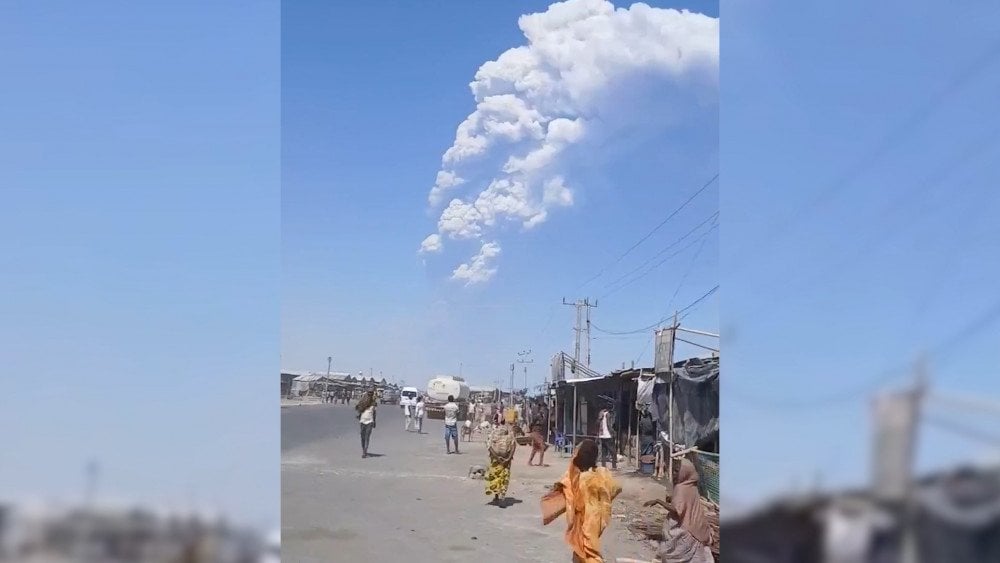
Rare eruption of the Hayli Gubbi volcano in Ethiopia — the first time in nearly 12,000 years
IASI-C satellite data detected an SO₂ plume with a total mass exceeding 58,000 tons.
The plume remained in the atmosphere after the eruption, moving across the Red Sea toward Oman and Yemen.
It should be noted that until November of this year, the volcano had no confirmed eruptions for nearly 12,000 years, and the observed activity had been limited only to gas emissions. The sudden awakening of Hayli Gubbi has become further evidence of increasing geological activity on the planet.
Australia
On November 22, severe Category 3 tropical cyclone Fina struck Australia’s Northern Territory, bringing winds with gusts of up to 200 km/h (124 mph) and record-breaking rainfall.
The following day, in the Middle Point area, 430 mm (16.9 in) of rain fell within 24 hours — an absolute record for the local weather station. November records were also broken in the city of Darwin and other settlements.
The damage was significant: due to waterlogged soil, century-old trees fell, damaging homes and vehicles. About 19,500 people were left without power. The storm also damaged the roof of the Royal Darwin Hospital.
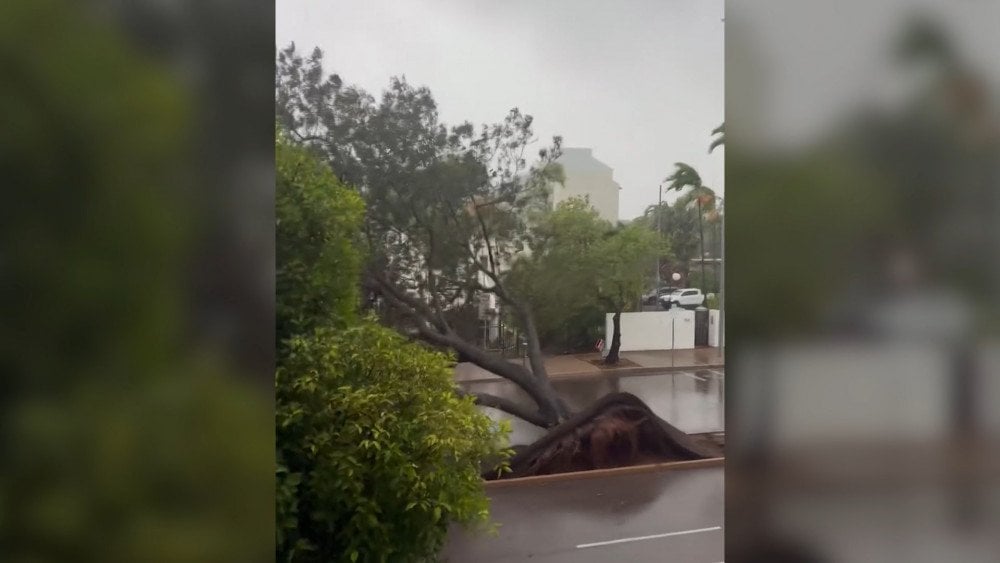
In Australia, powerful winds caused by Cyclone Fina uprooted trees
The Tiwi Islands were hit even harder, with power infrastructure sustaining damage.
Fortunately, there were no casualties.
After weakening, on November 25 the cyclone made landfall on the remote coast of the Kimberley region in Western Australia, causing wind gusts of up to 170 km/h (106 mph) near the mouth of the Berkeley River.
At the same time, the east coast of Australia was hit by a powerful spring storm. The states of Queensland and New South Wales found themselves at the epicenter of the disaster.
On November 24, southeastern Queensland, including the cities of Brisbane, Logan, and the Gold Coast, was hit by a dangerous thunderstorm. It brought destructive winds exceeding 100 km/h (62 mph). And in Chandler, a suburb of Brisbane, giant hail fell, with stones reaching up to 14 cm (5.5 in) in diameter.

Giant hail fell in Chandler — a suburb of Brisbane, Queensland, Australia
As a result, more than 150,000 homes in the region were left without power; vehicles, building roofs, and solar panels were severely damaged. Hurricane-force winds damaged hundreds of power lines, and about 880,000 lightning strikes were recorded in a single day.
The storm caused widespread destruction in the Moreton Bay area, the Sunshine Coast, and on Bribie Island. Fallen trees and debris blocked roads and disrupted rail service. Dozens of schools were closed across the region.
This storm was officially declared an “insurance catastrophe” due to the enormous damage caused to infrastructure and private property.
Sri Lanka
On November 22, after several days of torrential rain, a powerful landslide occurred on a section of the Colombo–Kandy main road in Pahala-Kadugannawa area, Kegalle District, Sabaragamuwa Province.

A powerful landslide destroyed a residential house and a roadside shop in Pahala-Kadugannawa area, Kegalle District, Sabaragamuwa Province, Sri Lanka
Fearing repeated slope failures, authorities completely closed one of the busiest and most important sections of this road for 24 hours.
The tragedy could not be avoided: a large mound of earth along with massive boulders from the slope below the railway tracks collapsed onto a residential house and a roadside shop — a popular stop for travelers.
At the moment of the collapse, staff and visitors who had stopped for breakfast were inside. Ten people were trapped under the debris. Several cars parked nearby were also damaged.
The Sri Lanka Army, fire service, police, and local residents were involved in the rescue operations. Four injured people were taken to hospital. Sadly, six people could not be saved.
Bangladesh
According to the Bangladesh Meteorological Department (BMD), on the morning of November 21, at 10:38 a.m. (LT), a magnitude 5.7 earthquake struck the central part of the country, in the Madhabdi area of Narsingdi District. The epicenter was located about 13 km (8.1 mi) east of the capital, Dhaka. The hypocenter lay at a depth of approximately 10 km (6.2 mi).

Moment of the magnitude 5.7 earthquake in Bangladesh
Many residential and industrial buildings sustained serious damage: in Dhaka, cracks appeared in walls, plaster crumbled, and roofs were partially destroyed. As a result of the disaster, at least 10 people died and more than 300 were injured.
The reason for such severe and tragic consequences, despite the moderate strength of the earthquake, was the vulnerability of urban infrastructure: dense construction and old buildings with unreinforced brick or concrete walls that are easily damaged during tremors, while closely spaced houses collide with each other during oscillations, causing falling debris and creating additional danger for residents. The destruction was further exacerbated by local geological features — soft, water-saturated soil of the Ganges–Brahmaputra delta, which amplifies seismic waves and increases the risk of structural damage.
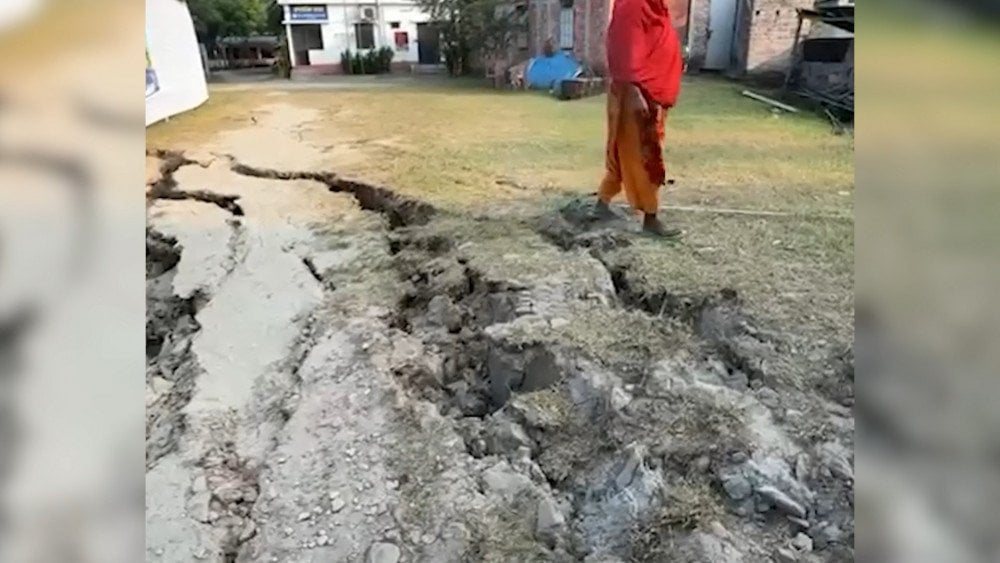
Deep cracks in the ground after the powerful earthquake in Bangladesh
Within the 32 hours following the main shock, three aftershocks with magnitudes of up to 4.3 were recorded in the region.
Thailand
Relentless torrential rains over the past week turned into a large-scale disaster for 10 provinces in southern Thailand, affecting more than 2.7 million people. Around 45,000 residents were forced to evacuate urgently. Due to flooded tracks, the State Railway of Thailand temporarily suspended train services on the southern line.
Hundreds of tourists were stranded in hotels and at the airport, unable to leave the disaster zone.

Evacuation of people from flooded areas in southern Thailand
On November 25, authorities declared a state of emergency, deploying the army, helicopters, a flotilla of 14 boats, and even the country’s only aircraft carrier, HTMS Chakri Naruebet, for rescue operations.
The most severe situation developed in Hat Yai District, Songkhla Province, which experienced its worst flooding in 25 years. The city of Hat Yai, a major business and tourist hub, was hit by record rainfall. At Hat Yai Airport, from 7:00 a.m. on November 21 to 7:00 a.m. on November 22, 370.2 mm (14.6 in) of precipitation fell.
Water levels rose to 2.5 m (8.2 ft), forcing many people to spend several days on rooftops without food or water.
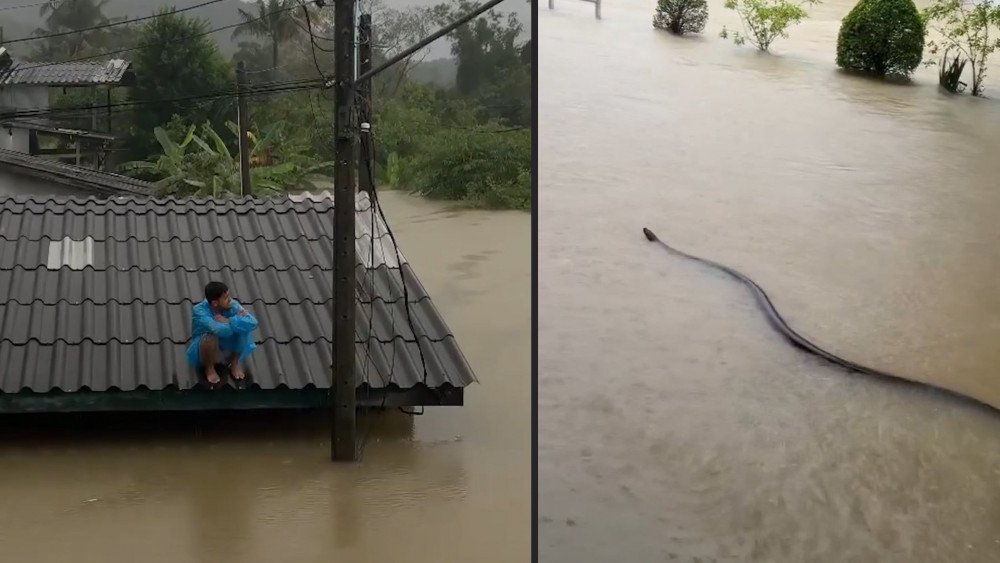
Severe flooding in Thailand: residents take refuge on rooftops while large snakes float through the streets
The main hospital in Hat Yai, which housed 600 patients, including 50 in intensive care, was flooded. Helicopters were used to deliver food and generators and to evacuate critically ill patients. Thirty newborns in the neonatal ward were also in danger when water flooded the bottom two floors of the building.
The disaster claimed the lives of 33 people. Most of them drowned or were killed by electrocution.
This deadly flood was caused not by a tropical cyclone, as is typical, but by a stationary low-pressure zone that unleashed a so-called “rain bomb” on the region.
A “rain bomb” is a phenomenon where an enormous volume of precipitation falls over a very short period, comparable to the impact of a powerful tropical cyclone.
Predicting this turn of events was only possible two hours before the water rushed into the city; moreover, it happened in the middle of the night, leaving very little time for preparation and evacuation.
Each new week of natural disasters is no longer just a news summary, it is someone’s final seconds of life, someone’s destroyed home, someone’s family that will never be together again. Climate disasters are increasing in number, yet people continue to live as if all this is happening to someone else.
Humanity keeps wasting energy on meaningless conflicts, building illusions about the future, getting drawn into wars — as if everything terrible were unfolding somewhere far away, on another planet.
But here is the question we find ourselves asking more and more often: what else must happen for the world to finally wake up? How many cities must vanish? How many people must burn, drown, or die under the rubble? Half the world?
But any one of us could end up in that “half” of the world. Our families, our children, our homes, our lives.
We are used to thinking this does not concern us, and we often hide behind the phrase: “But what can I do?”
But let’s be honest — this isn’t about helplessness; it’s about indifference. We have pretended for too long not to notice what is happening; we have put off action until tomorrow for too long.
So let’s stop lying to ourselves. Either we admit that we don’t care, or we start acting.
Acting not out of fear, not for some abstract future, but so that we actually have a tomorrow at all.
Watch the video version of this article here:
Leave a comment