Summary of Climate Disasters on the Planet, March 2–8, 2026
A rare earthquake in the United States.
Destructive winds comparable to a typhoon in Malaysia.
Failed landing attempts and panic on board an aircraft in South Korea.
A deadly squall in Indonesia.
Further in the article — details of these and other anomalous natural events of the past week, from March 2 to 8, 2026. And most importantly — we will discuss the causes behind this chain of disasters.
Indonesia
On March 3, after heavy rainfall, a cold lahar descended from the slopes of Merapi, one of the most active volcanoes in Indonesia.
A mass of mud, ash, and rocks, washed down by rainwater, rushed with tremendous force along river channels and struck several villages in the Magelang Regency, Central Java Province.
As a result, large areas were covered with volcanic deposits whose thickness in some places reached 10 m (33 ft). A state of emergency was declared in the region.
Roads and bridges were destroyed, residential and commercial buildings were damaged, and in one village, the water supply system was put out of operation.
Tragic events occurred in the sand mining area along the Senowo River: quarry workers were caught off guard by the lahar. More than 10 trucks and two excavators were buried under the mud and rock mass, and several people were swept away by the flow. A video circulating on social media shows one of the workers clinging to the top of an excavator to avoid being carried away.
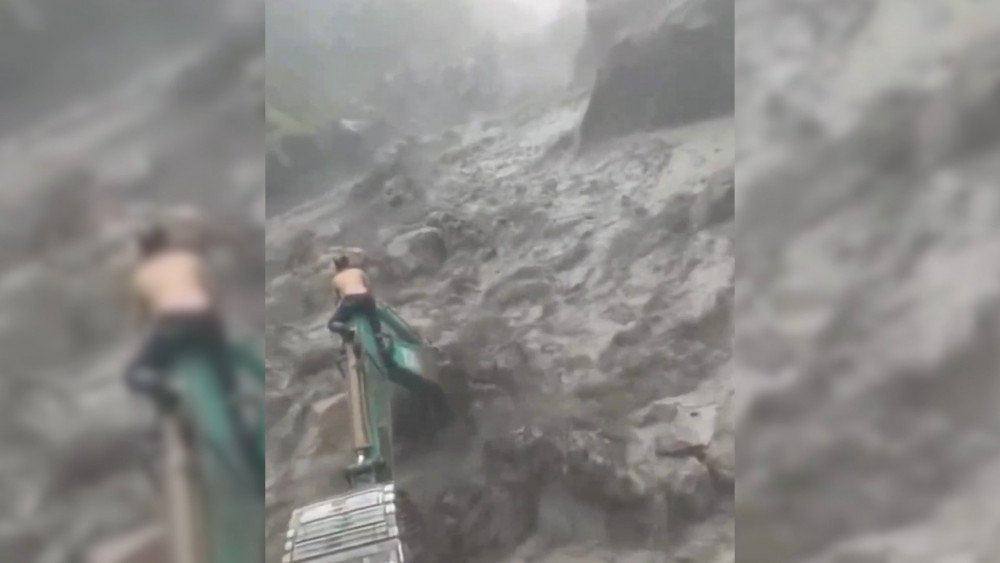
A worker clings to an excavator arm to avoid being swept away by a mudflow descending from the slopes of Merapi, Central Java Province, Indonesia
Rescue teams with heavy equipment arrived at the scene, and the search area was expanded to 7 km (4.3 miles) from the point where people were swept away. The bodies of two victims were found among large rocks about 3 km (1.9 miles) from the site.
As a result of the disaster, three people died, two are missing, and six were injured.
Strong gusty winds struck several regions of Indonesia, toppling trees and billboards, causing road blockages.
One of the most tragic incidents occurred in the city of Surabaya, East Java Province.
On March 2, a team of industrial climbers was washing windows on a high-rise building while working on suspended platforms. Suddenly, a violent storm broke out. Noticing the approaching storm, they decided to stop working. However, heavy rain and gusty winds struck before the two workers had a chance to get down.
Due to sudden squalls, the suspended platform began to swing at approximately the 26th floor and slam against the building wall. One of the workers became entangled in the safety ropes and fell from the platform. He suffered severe head injuries after crashing into the wall and died. The second worker survived and was hospitalized with injuries.

Squall winds shake a suspended platform — a worker hangs on a safety rope, Surabaya, East Java Province, Indonesia
Malaysia
On the evening of March 6, a powerful storm struck several regions of Malaysia, which eyewitnesses compared to a typhoon.
Around 6 p.m., heavy rain and gusty winds hit Putrajaya — the administrative capital of Malaysia — as well as several cities in the states of Selangor and Perak: Cyberjaya, Kajang, Bangi, and Ipoh.
In the city of Cyberjaya, the disaster struck a Ramadan market. Market stalls, along with goods, were blown away by the wind, while vendors desperately tried to hold them down. The storm also raged in residential areas of the city, where a large tree crushed a parked car.
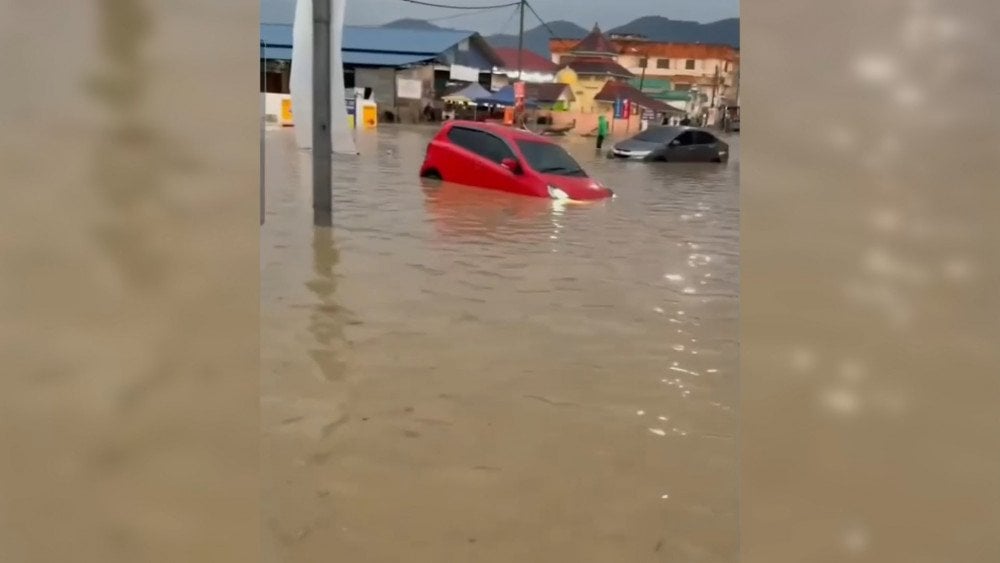
Aftermath of a powerful storm in Malaysia
In the city of Ipoh, Perak State, the area around the Senta Mall shopping center was affected.
The next day, March 7, the storm moved to the northwest of the country. In the city of Seberang Perai, Penang State, hurricane-force winds damaged 34 homes. In the Kampung Tasik area, a massive tree fell onto a residential house. The incident also caused power line failures.
Paraguay
On March 3, a short-lived but powerful storm struck the city of Asunción, causing severe destruction within minutes.
The most critical situation developed in the city center. Fallen trees damaged parked cars, streetlights, and power lines, blocking traffic at several intersections.

Strong winds toppled trees on the streets of Asunción, Paraguay
Before clearing the roads, it was necessary to call in technicians from the National Electric Company because broken wires and cables had become tangled in the tree branches, posing a danger to the workers.
Districts of Asunción — San Lorenzo, Lambaré, and Villa Elisa — were left without electricity.
In the Barrio Obrero area, part of a sports club wall collapsed due to strong winds.
The storm also caused dangerous flash flooding on city streets.
South Korea
In early March, a strong wind warning was in effect for two days in the South Korean city of Busan. Wind gusts reached 29.5 m/s (66 mph).
Gusts were also recorded in the districts of Saha-gu — 25.4 m/s (57 mph), Yeongdo-gu — 21.7 m/s (49 mph), and Haeundae-gu — 19.5 m/s (44 mph).
Videos circulated on social media showing people barely able to stay on their feet.
The severe weather caused numerous damages: retaining walls and parts of building facades collapsed, signs, banners, and trees fell. A squall shattered the glass storefront of a hotel.
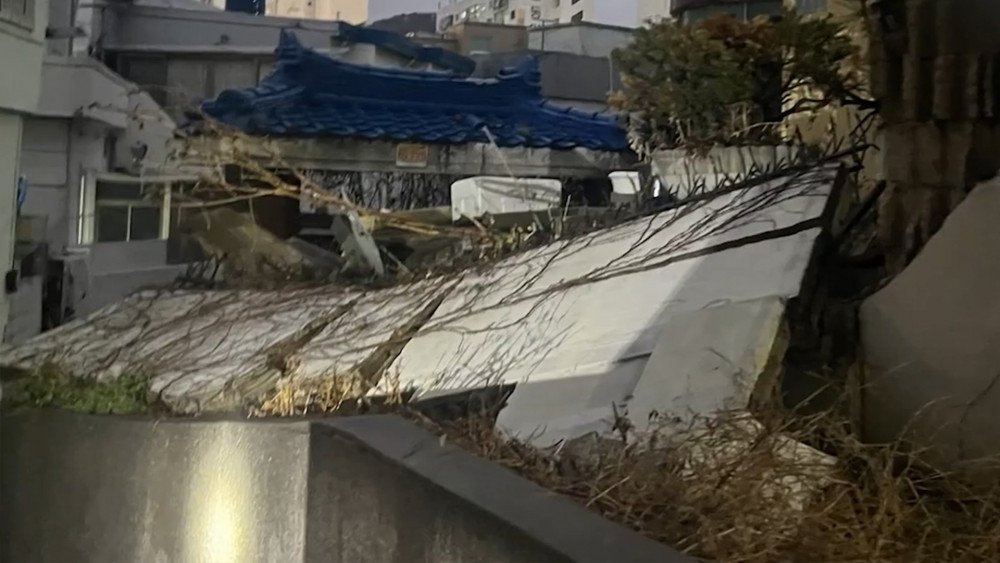
Wind gusts damaged the roof and walls of a building in Busan, South Korea
Within 24 hours, from March 2 to 3, at least 28 such incidents were recorded.
Power outages were also reported.
Strong winds also disrupted operations at Gimhae International Airport: due to gusts exceeding 20 m/s (45 mph), aircraft had difficulty landing.
On a flight from Tokyo, one passenger panicked after several failed landing attempts, and the aircraft was diverted to the city of Daegu for refueling. The crew then attempted to land again at Gimhae, but this attempt was also unsuccessful. Ultimately, the aircraft had to land at Incheon Airport.
The squally winds were accompanied by rain — in some areas, about 27 mm (1.1 inches) of precipitation fell.
Kenya
On March 5, heavy rains triggered sudden large-scale flooding in the country’s capital — Nairobi. The disaster claimed the lives of at least 42 people. Some drowned, while others died from electric shock.

Destructive flooding in Nairobi, Kenya: raging waters carry away vehicles
Traffic jams paralyzed movement in the city, and many people were trapped inside their vehicles by the floodwaters.
The military was deployed to assist emergency services.
The flooding damaged more than 100 vehicles, some of which were overturned by the current.
Air traffic was disrupted. According to Kenya Airways, some flights had to be diverted to the coastal city of Mombasa.
In the main natural park, Karura Forest — one of the most popular places for walking and hiking in Nairobi — rivers overflowed their banks, flooding parts of the area and forcing the temporary closure of popular trails to caves, bridges, and waterfalls.
United States
Since March 5, an explosive collision of warm, moist air from the Gulf of Mexico with a cold northern front has triggered a widespread outbreak of extreme weather across the central United States. Dangerous tornadoes, large hail, and destructive winds swept through the region, leaving a trail of devastation across 12 states. More than 100,000 people experienced power outages.

A tornado lifts dust and debris into the air in the town of Three Rivers, United States
Southwestern Michigan — including Cass, St. Joseph, and Branch counties — was particularly hard hit.
A powerful EF3 tornado, with wind speeds of up to 241 km/h, swept along the shore of Lake Union. It shattered the ice cover, destroyed houses and cottages, and some buildings were ripped from their foundations. A mobile home was lifted into the air and thrown about 90 m (295 ft) — its resident died. In total, three people died near the lake, and at least 12 were injured. Weakening, the tornado continued its path through the town of Union City, causing further destruction.
This vortex became the earliest EF3 or stronger tornado ever recorded in the state of Michigan (over the past 26 years, only three such tornadoes have occurred in Michigan). Previously, the earliest recorded was an EF3 tornado on March 15, 2012, north of the city of Ann Arbor.
Another powerful EF2 tornado passed through the town of Three Rivers.
Winds reaching up to 209 km/h (130 mph) tore roofs off buildings, toppled trees and power lines, and lifted clouds of debris into the air.
The tornado itself lasted only a few minutes, but the consequences of the destruction will take weeks and even months to repair. Over more than 1.5 km (0.9 miles), West Broadway Street was covered with wires, sheet metal, and shattered glass.
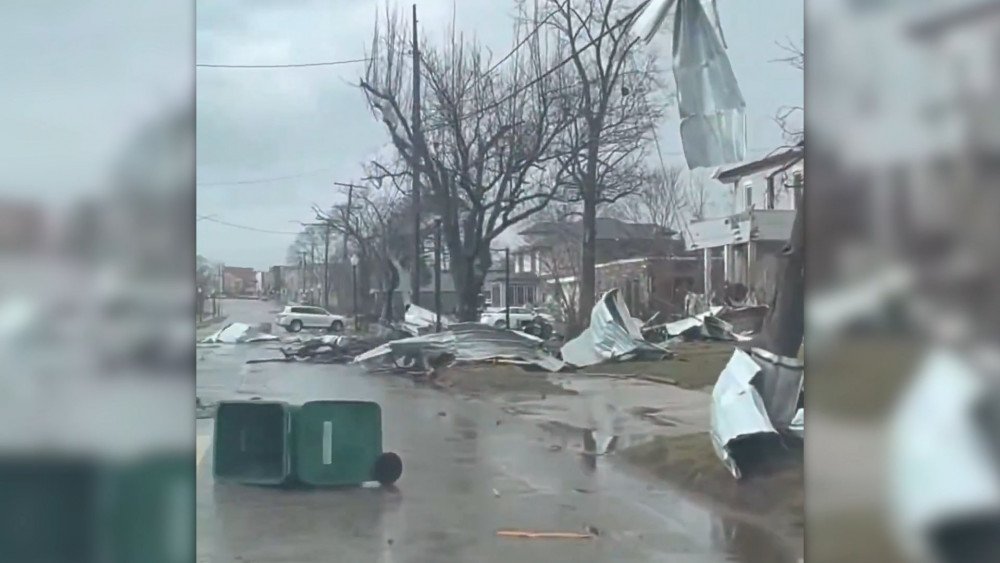
Aftermath of destructive winds in the United States: metal sheets, containers, and building debris scattered across the streets
Several businesses and public buildings suffered serious damage, including a high school. A local supermarket, restaurant, hotel, and emergency department were damaged.
Fortunately, there were no fatalities in Three Rivers, but 10 people were injured. Eyewitnesses report that the disaster struck suddenly: just 20 minutes before impact, the sky was clear and the sun was shining.
In Cass County, an EF1 tornado claimed the life of a 12-year-old boy, and several people were injured.
This was the deadliest day of tornadoes in Michigan in the past 46 years.
On the night of March 6, at least seven tornadoes were recorded in the state of Oklahoma.
West of the city of Fairview, in Major County, a powerful EF2 tornado swept a car off U.S. Highway 60, carrying a woman and her teenage daughter. Tragically, they died.
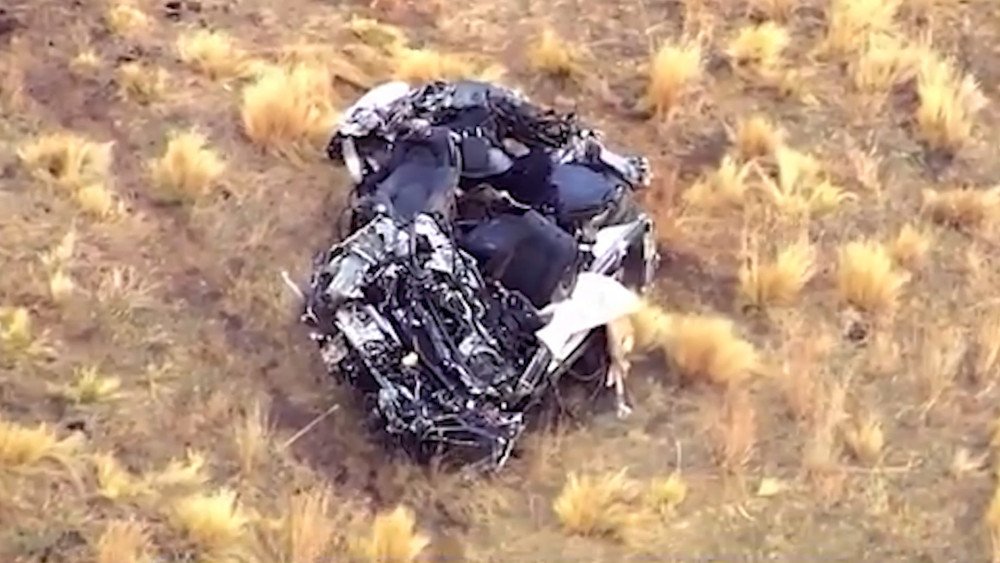
All that remains of a car swept off the road by a powerful tornado in Major County, Oklahoma, United States
Another EF3 tornado, with wind speeds up to 233 km/h (145 mph), struck the town of Beggs in Okmulgee County. In one of the four homes destroyed by this tornado, a married couple was killed.
Early in the morning, at 05:30 LT on March 5, northwestern Louisiana was suddenly shaken by a M4.9 earthquake. The epicenter was located near the small town of Coushatta, approximately 80.5 km (50 miles) from Shreveport, and the hypocenter lay at a depth of just 5 km (3.1 miles).
Beds shook in residents’ homes, walls vibrated, and dishes and pipes rattled. The United States Geological Survey received more than 1,100 reports of shaking, which was felt even in eastern Texas and southwestern Arkansas. This seismic event became one of the most powerful in Louisiana’s history.
In this region, a stronger quake — M5.3 — was recorded only once, in 2006, in the Gulf of Mexico far from populated areas, whereas the March 5 earthquake occurred on land and was felt by people.
Although a M4.9 earthquake is not considered destructive and no damage was reported, scientists are concerned about the increasing seismic activity in the region. Since early December 2025, 15 earthquakes of M2.5–4.9 have already been recorded in northwestern Louisiana, even though the area is considered to have low or nearly absent seismic activity.
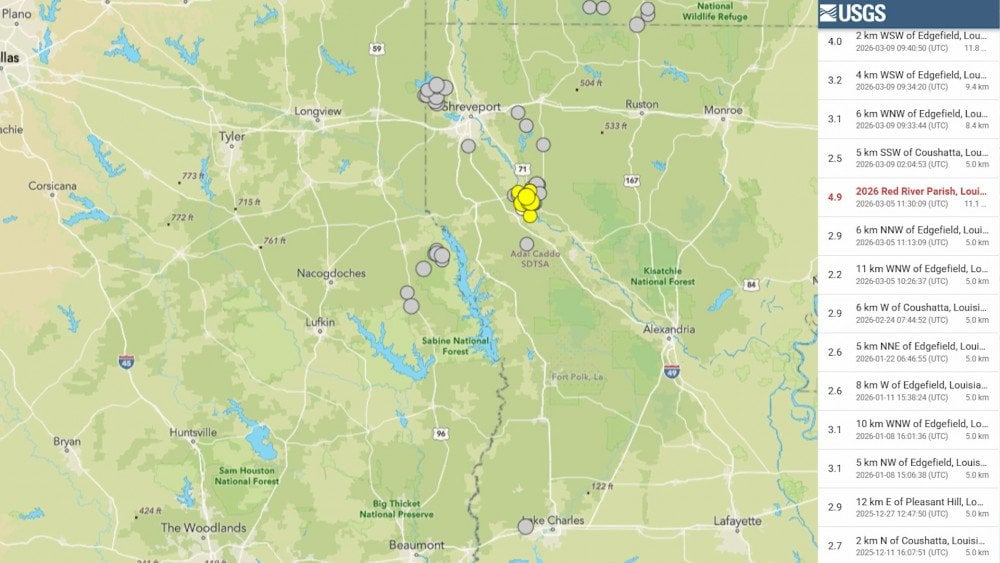
Map of seismic activity in the state of Louisiana, United States
Another alarming signal was the frequency of tremors: on March 9, near the town of Edgefield, four earthquakes of M3.1–4.0 occurred within just 10 minutes. Two of them rank among the four strongest in Louisiana’s history.
According to the United States Geological Survey (USGS), a M4.0 earthquake was recorded 7.9 km (4.9 miles) northwest of Edgefield at a depth of approximately 4.8 km (3 miles). After further analysis, the magnitude of this earthquake was revised to 4.4.
To understand why so many anomalous natural events are now occurring worldwide — events people have not encountered before — it is important to look deeper, at the level of physical processes. Our planet is a vast physicochemical system where thermal, potential, and kinetic energy are constantly transforming into one another. These energy transformations drive the processes we observe on the surface. But today, this balance is seriously disrupted.
A colossal source of energy on the planet is the ocean. Magmatic processes beneath the oceanic crust heat its waters, forming a massive reservoir of thermal energy. In the past, this excess heat was relatively quickly transferred to the atmosphere and then dissipated into space, allowing the ocean and atmosphere to maintain a stable energy balance.
Today, the situation has changed. Pollution of the ocean with micro- and nanoplastics affects heat exchange between water and the atmosphere. Plastic particles act as a thermal insulating layer, reducing the ocean’s ability to release accumulated heat, which in turn intensifies evaporation processes.
As a result, the kinetic energy of the atmosphere increases — the energy of air movement: winds, cyclones, hurricanes. The higher the speed of airflows, the more powerful these phenomena become. We already see how tropical cyclones rapidly intensify to record categories, and hurricane-force winds occur in places where they were previously rare.
At the same time, the potential energy of the atmosphere is increasing, due to the vertical movement of air masses and the release of latent heat during precipitation.
Another factor is forming in parallel — the accumulation of electrical charges in the atmosphere. Nanoplastics can retain charge due to the so-called electret effect, effectively creating a kind of energy “capacitor” in the atmosphere.
Previously, the energy chain functioned like a precise mechanism. Now, due to the harmful impact of plastic, part of the energy becomes trapped within the Earth’s system.
This affects not only climatic but also geodynamic processes.
What we observe today in the form of destructive winds, extreme precipitation, and unusual earthquakes are not isolated random events, but links in a single chain of processes occurring within the complex energy system of our planet.
That is why phenomena that were once considered rare are now occurring more frequently and are already increasing exponentially, as confirmed by statistics. Under these conditions, it is critically important to direct the full scientific potential toward studying the impact of micro- and nanoplastics, since this problem has already reached a planetary scale and cannot be resolved without intervention.
Watch the video version of this article here:
Leave a comment